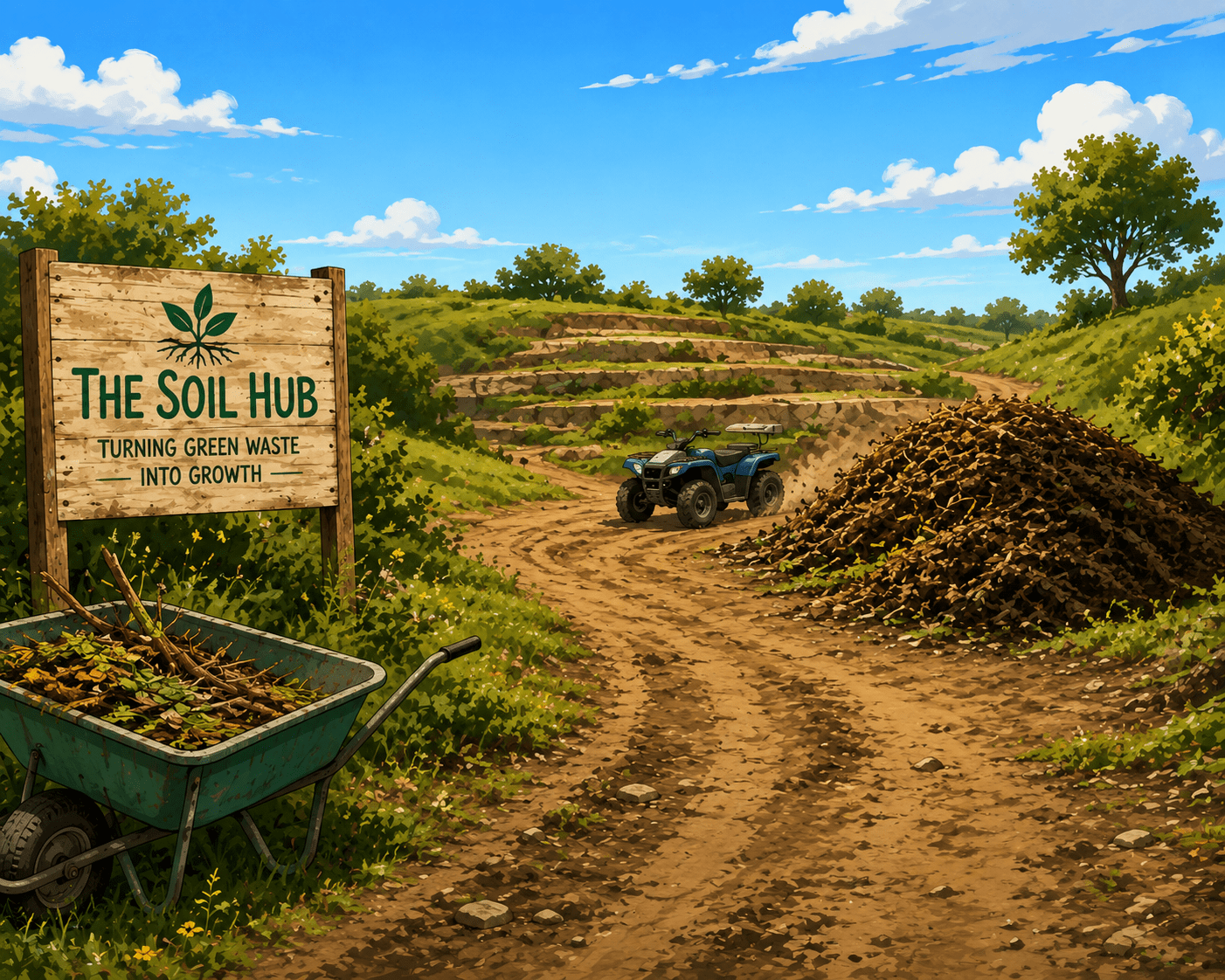
| It wasn’t that long ago that I published an article titled “The Soil Hub Finally Having a Home.” That journal entry was published on 23rd June. Sadly, less than two weeks later, on 6th July, I received a message from the prospective landlord to say he had changed his mind and now wanted to build on the land instead. It was another significant setback. At that point, I genuinely began to wonder whether it was time to put the entire concept to bed. For a while, I seriously considered abandoning the idea altogether. The dream of creating a place where we could transform our clients’ green waste into valuable soil-improvement materials once again seemed to slip further out of reach. The timing could hardly have been worse. I currently have close to 60 tonnes of green waste stored on the temporary field we use for holding material before processing. If I had lost the ability to continue the project, all that waste would have had to be collected and professionally disposed of. I estimated the cost could easily have been somewhere between £600 and £1,000, which would have been another substantial financial blow. Then, a couple of weeks ago, Lady Luck finally decided to smile. I don’t have any photographs to share just yet—perhaps that’s for the best, as I don’t want to tempt fate—but a friend introduced me to a local farmer. We met, walked the land together, and he showed me a piece of barren, infertile horticultural ground. It is roughly twice the size of the parcel I had been offered back in June and, despite its appearance, I immediately knew it was exactly what I had been looking for. All being well, we will be taking up residence there sometime this month. The journey to this point – it began as a quest in November 2023 – has certainly been an eye-opener. Throughout this project I’ve encountered more than a few people who enthusiastically told me how much they loved the concept and how important it was for the environment. Unfortunately, that enthusiasm often came with surprisingly expensive price tags. Every benchmark I had was based on people asking around £300 per month for relatively small strips of land. My current temporary storage area, measuring approximately 75 feet by 15 feet, costs £300 per month, and the larger plot I was offered back in June costs £300 per month as well. So you’ll understand why the conversation with the farmer completely caught me off guard. After we’d walked around the land—about a third of a mile from the roadside, rocky, terraced, barren and, by most standards, fairly undesirable—he turned to me and asked whether I was interested. “Yes,” I replied. “Very interested. How much are you looking for?” “Make me an offer,” he said. I laughed and admitted I wasn’t very good at this sort of thing. “I can only go by what everyone else has been charging me.” “Go on then,” he smiled. “Tell me.” I hesitated before saying, “Would £300 a month be too little?” His response was immediate. “£300? Are you insane?” For a moment I genuinely thought I’d offended him. Then he smiled. “That’s far too much. Try again.” I stood there completely confused. “Too much?” I asked. “Okay… what about £100 a month?” He laughed. “You’re terrible at this. Let me help you. Fifty pounds a month. Cash. No paperwork, no invoices. Just £50 in my hand each month. How does that sound?” I was completely taken aback. Needless to say, I accepted immediately. Curious, I asked why he was charging so little. His answer was wonderfully straightforward. “People around Sandwich can be greedy. Always have been, always will be. Besides, if I charge too much, I only end up paying more tax.” And just like that, after months of searching, setbacks and disappointment, The Soil Hub finally has somewhere to call home. By most people’s standards, it’s terrible land. Nothing much grows there. There are no plans to build on it, no commercial ambitions, and no expectations. The farmer’s grandsons use the surrounding dirt track as a quad-bike circuit, while I have use of the land inside the track and the surrounding margins. To many, it wouldn’t look like much. To me, it’s absolutely perfect. There is still a great deal to work out before anything begins. The logistics, the layout, and the practicalities all need careful thought. In fact, we’ve already decided to make some significant changes to the original concept, which will make The Soil Hub even stronger in the long term. I’ll share more about those plans very soon. |

| About our writing & imagery Most articles reflect our real gardening experience and reflection. Some use AI in drafting or research, but never for voice or authority. Featured images may show our photos, original AI-generated visuals, or, where stated, credited images shared by others. All content is shaped and edited by Earthly Comforts, expressing our own views. |


Hi there, I have just subscribed. Have you any advice for those who can only grow in raised beds? How is it best to maintain the quality of the soil/compost that is in these beds?
Just asking, Thanks, Graham. ________________________________
LikeLiked by 1 person
Hi Graham, and thanks for commenting.
Absolutely. We actually have an allotment here in Sandwich where we grow much of our produce using raised beds, so it’s something we work with regularly.
One thing we’ve definitely noticed over the years is that the soil level naturally drops. That’s completely normal. Organic matter gradually breaks down, the soil settles, and each year’s crops remove nutrients from it. Because of that, we top our beds up a little each year rather than replacing all the compost.
Our general approach is:
• Add organic matter every year. A layer of good-quality compost or well-rotted manure (around 2–5 cm) each autumn or spring helps replace what crops have used and keeps the soil full of life.
• Avoid digging too deeply. We spread compost on the surface and let worms and the natural soil life do most of the work.
• Rotate crops where possible. Even in smaller raised beds, it helps reduce pests, diseases and nutrient depletion.
• Feed hungry crops. This season, we’ve been using Tomorite alongside our homemade weed feed (made by soaking weeds in water, then straining the liquid) and seaweed feed. The combination has worked really well for us.
• Water deeply rather than little and often. With the prolonged hot weather we’ve had this year, we’ve found that giving the beds a thorough soak less frequently encourages the roots to grow deeper, making the plants much more resilient during the hotter spells.
• Mulch the surface where possible. It helps retain moisture, suppress weeds and gradually improves the soil as it breaks down.
Suze has also been trialling Vitax Slug Gone Wool Pellets. They’re certainly not the cheapest option—and they do have quite a distinctive smell!—but we’ve been impressed with how well they’ve worked, particularly around young plants. A bonus is that they eventually break down, returning organic matter to the soil.
Overall, we’ve found that if you keep topping your raised beds up with fresh organic matter each year, feed the plants sensibly, and water deeply during dry periods, the soil continues to improve rather than deteriorate. We’ve never found it necessary to empty and replace all the compost.
I hope that helps, Graham. It’s a great question, and one I’ll cover in more detail in a post later this week because I’m sure plenty of other gardeners have wondered the same thing.
Happy growing!
Rory
LikeLiked by 1 person
Thanks for that – look forward to more advice.
Graham.
LikeLiked by 1 person