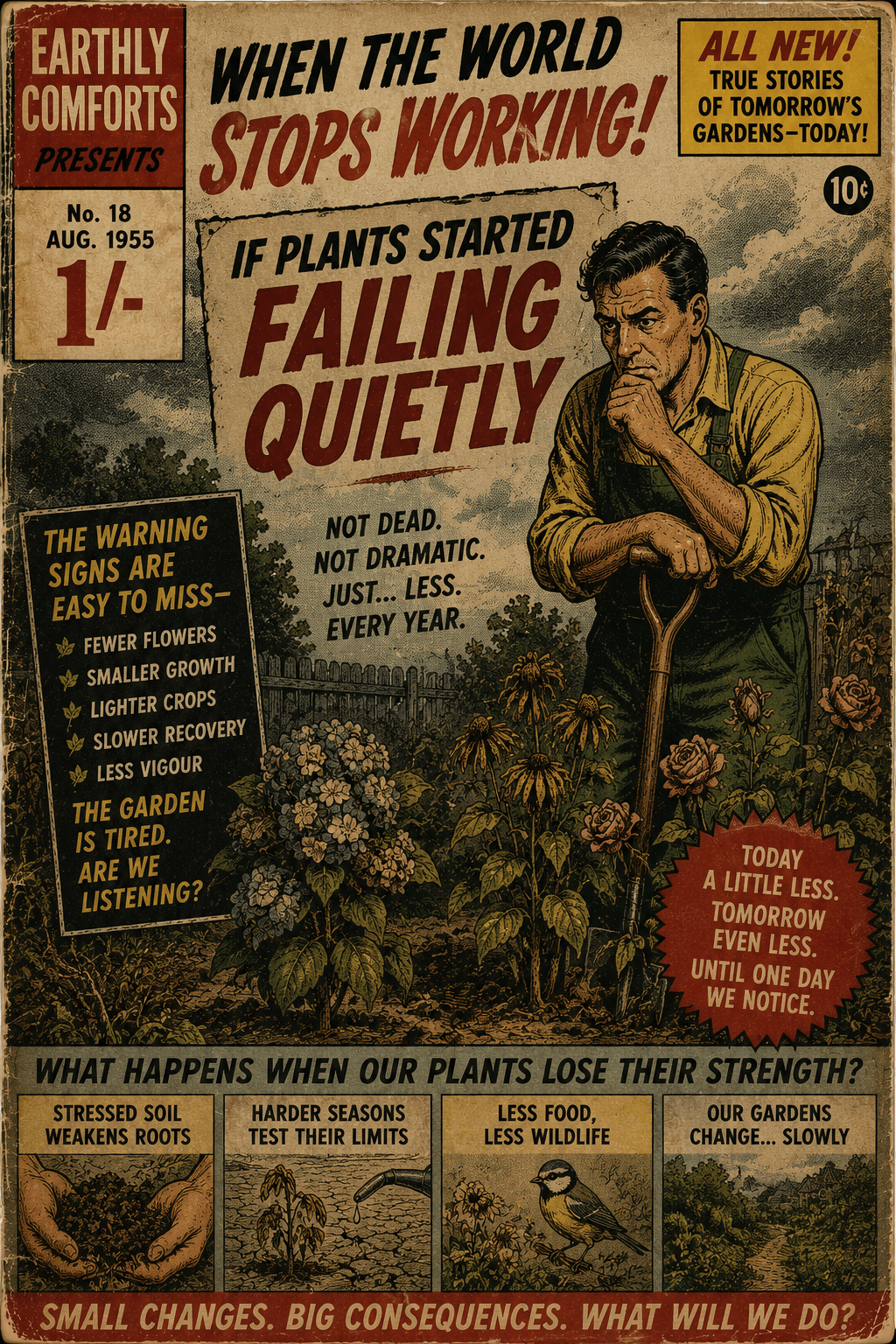
| Gardens are surprisingly good at telling us when something is wrong. Leaves yellow, stems wilt, flowers fail to appear, and plants that looked perfectly content last week suddenly collapse with all the subtlety of a Victorian heroine discovering bad news. With enough experience, you begin to recognise some of the signs. Too much water, too little water, poor soil, damaged roots, disease, frost, heat or simply a plant that has reached the end of its natural life. Gardening is full of small investigations, and there’s usually an explanation somewhere if you’re prepared to look for it. But what if there wasn’t? Not because every plant suddenly died. That would at least have the advantage of being obvious. Imagine instead that gardens became a little less successful each year. The roses still flowered, but not quite as generously. The lavender survived, although the plants never developed the vigour they once had. A shrub that previously put on a foot of growth each summer managed six inches, then four. Seeds germinated, but fewer of them. Trees produced blossom, yet somehow the fruit crop seemed lighter every autumn. Nothing individually looked alarming enough to cause concern. The garden wasn’t dying. It just wasn’t doing quite as well as it used to. At first we’d blame ourselves. Gardeners are remarkably accomplished at this. If a plant struggles, our immediate suspicion is often that we’ve done something wrong. Perhaps it needed feeding. Perhaps we pruned it at the wrong time. Perhaps that unusually wet winter damaged the roots, or the dry spring arrived before they had recovered. We’d add compost, improve drainage, mulch more deeply and pay greater attention to watering. The plant might respond a little, which would reassure us that we’d solved the problem, until the following year when something else began behaving strangely. Professional gardeners would notice the pattern before individual garden owners did. Working across many gardens gives you a broader view of what plants are doing. One struggling hydrangea means very little. Five struggling hydrangeas might be coincidence. When plants in completely different gardens begin showing the same lack of vigour, you start paying attention. You might find yourself saying things you’d never previously needed to say: That normally grows better than this, or I’d have expected much more growth by now. Eventually, those observations would begin to join together. The difficult part would be working out what had changed, because gardens don’t experience one thing at a time. A wet winter can be followed by a dry spring. A mild February can encourage early growth before an April frost damages it. Summer heat may arrive while soil moisture is already low. Plants survive each event, but survival isn’t the same as thriving. A tree can live through a difficult year while using stored energy to do so. A shrub can recover from drought but enter winter milder than it would otherwise have been. Repeat enough small stresses closely together and perhaps the plant never quite gets the opportunity to recover completely. That is where our imaginary apocalypse would begin: not with catastrophe, but with exhaustion. There would be no dramatic morning when Britain woke to find its gardens dead. Instead, the decline would hide inside ordinary gardening. A hedge would need slightly less cutting than it used to. At first, clients might consider this excellent news. Less growth means less maintenance, after all. The lawn would require less frequent mowing during summer. Again, nobody would complain. Roses would produce fewer flowers, but perhaps we’d blame the pruning. Fruit trees would carry lighter crops, but fruiting varies naturally from year to year anyway. Each change would have a perfectly reasonable explanation. It would only become disturbing when the reasonable explanations began piling up. Garden centres would respond with characteristic enthusiasm. There would be feeds for tired plants, tonics for stressed plants, treatments for plants that had apparently lost confidence and probably a premium bottle promising to restore natural vitality for £14.99. We’d buy some of them because gardeners are eternal optimists. If a plant has produced even one green shoot, most of us are prepared to spend another six months persuading ourselves that recovery is imminent. Sometimes we’d be right. Other times we’d eventually have to admit that the plant was fading. The temptation would be to replace it, but the replacement struggled too. Choose something supposedly more suitable, improve the planting hole, incorporate compost and water it carefully through the first summer. It would establish, but never quite flourish. The garden would begin to accumulate plants that were alive, without looking particularly pleased about it. There is something far more unsettling about that than outright failure. A dead plant presents a decision. You remove it and move on. A struggling plant offers hope, and gardeners can sustain hope for an extraordinarily long time. We will nurture a miserable shrub for years because one afternoon in May it produces three promising leaves and convinces us that everything has finally turned around. The garden, meanwhile, would continue becoming quieter. Not silent. That would be too obvious. Just quieter. There could be slightly less blossom, which meant slightly less food for pollinating insects. Fewer insects might mean fewer opportunities for birds feeding their young. Smaller fruit crops would provide less autumn food. Plants producing fewer seeds would affect creatures that rely on them for winter survival. Nothing would disappear immediately, but the effects would begin moving through the garden in ways that weren’t always easy to connect with the original problem. That is one of the things gardens teach you if you watch them for long enough: very little exists independently. We tend to look at plants as individuals because that’s how we buy them: one pot, one label, one price. But once planted, they become part of something much larger. Their flowers feed insects. Their leaves provide shelter. Their roots interact with soil organisms. Their fruit and seeds feed wildlife, while the material they eventually shed returns nutrients to the ground. A plant that becomes slightly less productive doesn’t merely look disappointing. It contributes slightly less to everything around it. Multiply that across an entire garden, and the difference begins to matter. Our response is to work harder. We’d feed more, water more and intervene more often because that’s what humans tend to do when something stops responding as expected. Yet eventually we might discover that greater intervention wasn’t always the answer. Plants already struggling with environmental stress don’t necessarily need us pushing them towards faster growth. They might need healthier soil, deeper roots, more shade, better water retention and considerably less disturbance. The successful garden would gradually become the one designed to cope rather than perform. That might change what we planted. The spectacular shrub requiring perfect conditions could lose its place to something less glamorous but considerably tougher. Plants that had survived twenty years in neighbouring gardens would suddenly seem more interesting than whatever happened to be fashionable that spring. We’d start paying much closer attention to provenance, soil conditions, aspect and water requirements rather than buying something simply because it looked wonderful beside the till. Older gardens might become unexpectedly valuable teachers. Something is reassuring about finding a plant that has survived decades of changing weather without anyone making much fuss about it. Those survivors may become our starting point. We’d propagate them, divide them and begin building gardens around plants that had already demonstrated their ability to cope with where we actually lived, rather than where a plant label suggested we lived. We may also become more protective of soil. Gardeners talk endlessly about plants because they’re the visible part of gardening, but almost every story eventually leads underground. Healthy soil holds moisture, drains excess water, stores nutrients and supports the enormous community of organisms upon which plants depend. If conditions above ground became increasingly unpredictable, the resilience beneath it would matter even more. Compost, leaf mould, mulches and organic matter would stop being optional improvements and become part of how we kept gardens functioning. There is, of course, a darker possibility. What if we did all those things and some plants still failed? That would be the moment the garden genuinely began to change, not to end, but to change. Species we’d considered dependable might gradually disappear from certain places. Others would take their place. Plants once associated with warmer parts of the country might become ordinary further north, while familiar favourites became increasingly difficult to maintain in southern gardens. The traditional planting calendar would become less useful because the conditions it was based upon no longer arrived reliably. Within a generation, the gardens around us could look subtly different. The interesting thing is that somebody visiting for the first time might not notice anything wrong. There would still be trees, shrubs, flowers and lawns. Bees would still visit flowers. Birds would still sing from hedges. Children would still play outside. The garden would remain recognisably a garden. Only the people who remembered what had been there before would see what was missing. That is what makes this particular thought experiment uncomfortable. We are very good at recognising sudden loss. A tree blown down in a storm leaves an enormous space, and everybody notices immediately. Slow decline is different. Each year becomes the new normal, and memory gradually adjusts with it. We forget how heavily the apple tree once cropped, how many butterflies used to visit the lavender or how vigorously the hedge grew twenty years earlier. Eventually, someone younger might look at the same garden and think everything appeared perfectly ordinary. Perhaps that’s why gardeners matter in ways we don’t always recognise. We are observers of repetition. We return to the same borders, trees and patches of ground through different seasons and different years. We remember when something normally flowers because we’ve seen it happen dozens of times. We notice when growth seems weaker, when seasons shift and when plants behave differently because our work depends upon noticing. We don’t need to turn every unusual season into a catastrophe. Gardens have always changed, and plants have always had good years and bad ones. But neither should we dismiss every change simply because nothing dramatic happened. If plants ever started failing quietly, the greatest danger might not be that we couldn’t save them. The decline happened slowly enough for us to become accustomed to it. The roses would still flower. The trees would still carry leaves. The garden would remain green enough to reassure us that everything was fine. And perhaps, one day, we’d look at an old photograph and realise just how much greener fine used to be. |
| About our writing & imagery Most articles reflect our real gardening experience and reflection. Some use AI in drafting or research, but never for voice or authority. Featured images may show our photos, original AI-generated visuals, or, where stated, images credited to others. All content is shaped and edited by Earthly Comforts, expressing our own views. |

