
| Case File 06 Britain’s Big Cats — Myth, Misidentification or Reality? Part 1 |
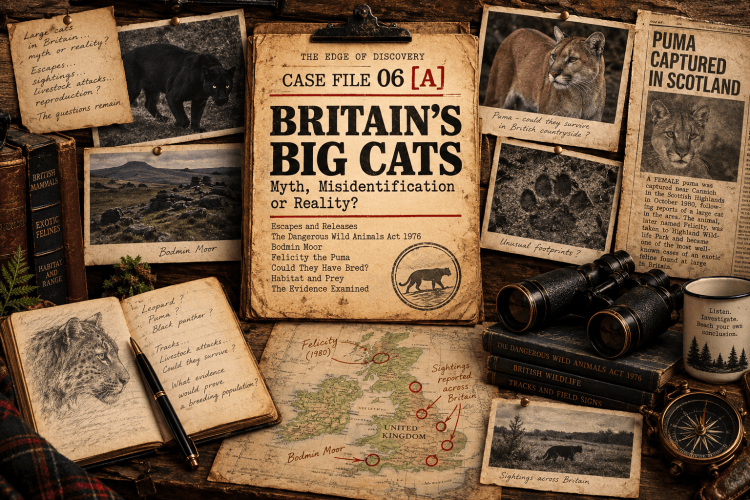
| From the Beast of Bodmin Moor to the consequences of the Dangerous Wild Animals Act, an investigation into how exotic felines came to be associated with the British countryside, and whether they could have survived there for generations. Britain’s relationship with large cats is rather peculiar. We readily accept that leopards can survive in the mountains of Asia, that pumas inhabit vast areas of the Americas, and that jaguars can move almost unseen through dense tropical forests. Yet suggest that a large exotic feline might be wandering through the English countryside, and the response is frequently a mixture of amusement, disbelief and the occasional raised eyebrow. Apparently, a leopard slipping unnoticed through a remote forest is perfectly reasonable, but one crossing a field in Lincolnshire is another matter entirely. For decades, people throughout Britain have reported encounters with animals they describe as pumas, leopards, panthers and other large exotic cats. Some sightings involve dark shapes moving across distant fields, while others describe substantial animals observed at relatively close quarters. Reports include unusual footprints, livestock attacks, strange calls at night, and, occasionally, physical evidence that has attracted serious attention from investigators. The creatures have acquired a collective identity: Alien Big Cats, usually abbreviated to ABCs. The word alien does not imply anything extraterrestrial, although I suspect that particular misunderstanding has occasionally provided a little entertainment. It simply refers to animals living outside their recognised natural geographical range. A leopard in Africa is perfectly ordinary; a leopard wandering through a British woodland would be considered an alien species. Unlike Bigfoot, the Yeti or the Loch Ness Monster, however, Britain’s big-cat mystery does not require us to discover an entirely unknown animal. We already know what leopards and pumas look like, how they behave, what they eat and how they reproduce. We understand their anatomy and have studied their ecological requirements for generations. The mystery is whether these familiar predators have found their way into an unfamiliar landscape and, more importantly, whether some have stayed long enough to establish themselves. It deserves far more attention than the familiar suggestion that every witness must have mistaken an oversized domestic cat for something exotic. Misidentification undoubtedly occurs, but it is not an explanation to apply indiscriminately before examining the circumstances of an observation. There is also a historical complication. We know that exotic large cats have escaped or been released in Britain, and we know that at least some have survived outside captivity. The debate begins when we attempt to move from individual animals to the possibility of successive generations living independently in the countryside. That is where this investigation begins. |
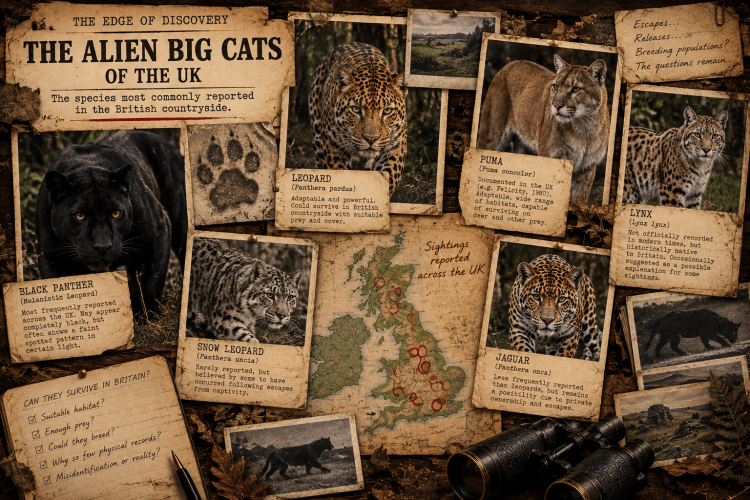
| Britain Was Once a Land of Large Predators It is tempting to imagine the modern British countryside as a landscape that has always belonged to deer, foxes, rabbits, sheep and the occasional badger conducting its nocturnal business. In reality, Britain’s natural history is considerably more adventurous. During prehistoric periods, large predators occupied landscapes that would eventually become the British Isles, including cave lions and other formidable carnivores. Later, wolves, bears and Eurasian lynx were among the predators inhabiting the country’s forests and uplands. The Eurasian lynx is particularly relevant to our investigation. This substantial wild feline once occurred in Britain, and archaeological evidence confirms its former presence. Its disappearance is generally associated with gradual landscape transformation and human pressures. However, the precise timing of its extinction in Britain remains the subject of ongoing research. The lynx is not comparable in size to a large male leopard or puma, but it is nevertheless a powerful predator capable of hunting sizeable prey. Its former presence demonstrates that the British environment has supported wild feline predators considerably larger than the domestic cats familiar to us today. Of course, historical evidence that lynx once inhabited Britain does not establish that exotic cats live here now. Past ecological circumstances were different, and a species’ ability to survive somewhere does not automatically mean it is present. Nevertheless, it is useful to remember that Britain is not a landscape somehow incompatible with feline predators. Indeed, one of the more interesting questions concerns what has happened to Britain’s potential prey populations since the disappearance of its larger native carnivores. Deer are now widespread, and several species have established substantial populations. Woodland, agricultural boundaries, rough grassland and river corridors provide a varied environment containing numerous potential food sources. If an adaptable large feline were introduced into such a landscape, would it necessarily struggle to survive? Not quite as much as some people might imagine. The Private Menageries of Britain Before examining the modern reports, we should consider how exotic animals came to be kept in Britain in the first place. The country’s fascination with unusual wildlife stretches back centuries, encompassing royal collections, travelling menageries, zoological gardens and private ownership. Lions, tigers, leopards and other exotic animals were displayed as symbols of wealth, prestige, scientific curiosity and, sometimes, little more than fashionable extravagance. During the nineteenth and twentieth centuries, exotic animal ownership became increasingly varied. Established zoological institutions maintained some animals, while others entered private collections or were kept by individuals with widely differing levels of experience. Standards of accommodation, welfare, and containment did not always match today’s expectations. Large cats have never been straightforward animals to keep. Their strength, intelligence, physical capabilities and behavioural requirements demand specialised knowledge and secure facilities. A leopard that appears perfectly content in an enclosure may still exploit a surprisingly small weakness in its construction. A puma, meanwhile, possesses remarkable agility and jumping ability, making containment considerably more complicated than simply erecting a tall fence. My own professional experience within the exotic livestock trade has given me an appreciation of how demanding the proper management of large mammals can be. Between 2001 and 2011, I worked as a broker dealing in exotic livestock and large mammal collections, including private collections, game parks, and importers supplying zoological institutions. Through that work, I encountered a considerable variety of feline species, from cheetahs to lions and tigers. That experience taught me that the distance between possessing an exotic animal and being properly equipped to care for it can be considerable. It also helped me understand why changes in legislation could present serious difficulties for owners who had acquired animals under earlier arrangements. Which brings us to a particularly important year in Britain’s big-cat story. 1976 — The Legislation That Changed Exotic Animal Ownership The Dangerous Wild Animals Act 1976 holds an almost legendary place in discussions of Britain’s alien big cats. According to one frequently repeated explanation, the legislation prompted private owners to release exotic predators into the countryside rather than face the expense and inconvenience of complying with new regulations. That suggestion has a plausible historical basis, but people often misunderstand the details. The Act did not simply make it illegal for private individuals to keep large cats. Instead, it introduced a licensing framework intended to protect public safety by ensuring that specified dangerous animals were kept under appropriate conditions. Owners became subject to requirements concerning accommodation, security, inspections and other responsibilities associated with maintaining potentially dangerous wildlife. For experienced keepers with suitable facilities, licensing provided a regulated way to continue ownership. For others, particularly those with less formal arrangements, the legislation could have created significant practical and financial difficulties. Secure enclosures, specialist inspections, administrative obligations and the possibility of alterations to existing facilities were not necessarily minor considerations. It is therefore understandable why some people have suggested that owners unwilling to meet the new requirements might have released their animals rather than surrendering them or arranging appropriate alternative accommodation. However, there is a distinction between an explanation that makes historical sense and one supported by comprehensive documentary evidence. We do not possess a reliable national inventory showing how many exotic felines were released specifically because of the Act, which species were involved or where those animals were supposedly abandoned. The familiar story of large numbers of pumas and leopards suddenly being turned loose across Britain should consequently be treated with caution. Some releases may have occurred, but the scale of the phenomenon remains uncertain. Another point is worth considering. Exotic animals did not cease to exist in private ownership after 1976. Licensed keeping continued, and escapes or deliberate releases could have occurred in subsequent decades. Any attempt to explain modern sightings must therefore consider more than one possible introduction period. And this leads to an unavoidable biological question. Even if adult leopards or pumas were released in 1976, those original animals would not still be alive today. Fifty years exceeds the normal lifespan of these species by a considerable margin. If the descendants of such animals are still wandering through Britain, reproduction must have occurred. But how realistic is that possibility? |
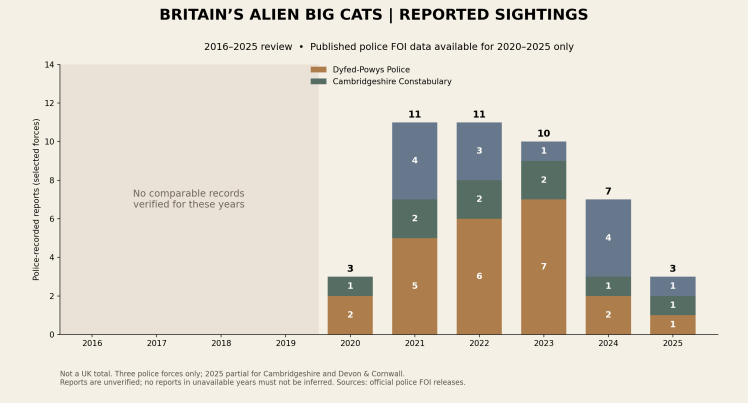
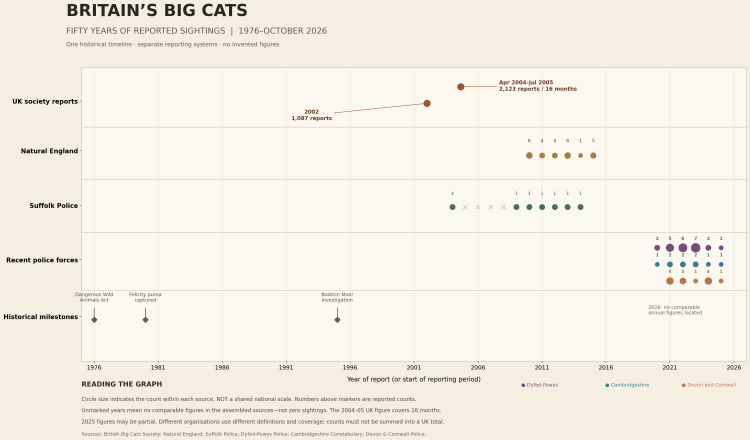
| Could Large Cats Have Bred in the British Countryside? This is where the mystery becomes considerably more complicated. An individual escaped leopard or puma surviving for several years is one thing. Establishing a breeding population capable of continuing for decades is something else entirely, and it requires us to consider animal behaviour, territorial ranges, reproductive biology and the availability of suitable mates. Large felines can occupy extensive territories, particularly in environments where prey is scattered. Male pumas, for example, may range across areas much larger than females, while leopards can travel substantial distances through varied terrain. Their territories are not necessarily isolated patches of countryside with clearly defined boundaries. Individuals may overlap, disperse or move considerable distances when seeking mates or establishing new territories. It would therefore be mistaken to assume that two compatible animals must have been released into the same woodland to have any possibility of meeting. A male and female released some distance apart might eventually encounter one another, provided both survived, occupied overlapping areas and were reproductively capable. Nevertheless, such circumstances would involve considerable uncertainty, particularly if the number of released animals was small. Even successful reproduction would not automatically establish a permanent population. Cubs would need to survive, mature and find suitable territories of their own. A population founded by very few individuals would face additional difficulties involving genetic diversity, inbreeding and ordinary mortality. Over several generations, these problems could become increasingly significant unless additional animals entered the population. Hybridisation is another issue, and I find it particularly interesting because of my own experiences with exotic mammals. I have seen a liger, the hybrid offspring of a male lion and a female tiger, and there is something quite extraordinary about standing in front of an animal that combines characteristics of two different species. Such animals demonstrate that reproductive boundaries between some closely related felines are not absolute. However, it would be a mistake to conclude that any two large cats could reproduce simply because lions and tigers can. Hybridisation depends upon genetic compatibility, and even when offspring are produced, fertility may be limited. A leopard and a puma cannot be assumed to establish a reproductive lineage merely because both belong to the cat family. The more plausible explanation for a successful wild population would involve compatible animals of the same species. Could that have happened in Britain? Biologically, we cannot dismiss the possibility outright. But possibility alone does not establish that it occurred, and the longer a population is supposed to have survived, the more evidence we should reasonably expect to find. A Countryside With Plenty on the Menu One argument frequently raised against the existence of Britain’s big cats is that they would struggle to find sufficient food. I have never found that particularly convincing as a general proposition, although habitat suitability depends on the feline species involved. Britain supports substantial populations of deer, including roe, fallow, muntjac, red and sika deer. Rabbits and hares provide additional prey, while smaller mammals and birds offer other opportunities. Agricultural land also supports livestock, although the presence of sheep or other domestic animals does not establish that exotic predators are taking them. Leopards are remarkably adaptable carnivores. Across their natural range, they occupy forests, grasslands, mountains, and landscapes heavily influenced by human activity. Their diet varies with local conditions, and they can take prey considerably larger than themselves. They are also powerful climbers, sometimes carrying carcasses into trees to reduce competition from other predators and scavengers. Pumas are similarly versatile, occupying habitats ranging from forests and mountainous regions to comparatively open landscapes. Their ability to exploit different prey species is one reason they have historically occupied such an extensive geographical range throughout the Americas. It is therefore reasonable to suggest that some parts of Britain could provide adequate food for individual leopards or pumas. The combination of deer, smaller mammals, woodland cover and agricultural boundaries would offer opportunities that an adaptable predator might exploit. However, food availability is only one component of a suitable habitat. Large cats also need opportunities to rest, move, avoid disturbance and, if reproducing, raise young successfully. Britain has extensive countryside, but it also has a dense network of roads, settlements, footpaths and agricultural activity. Even comparatively secluded areas are often visited by farmers, walkers, forestry workers, and others. A solitary animal might avoid direct observation for considerable periods, particularly if it were predominantly nocturnal. An entire breeding population would be more difficult to conceal. Multiple animals occupying territories across successive generations would create more opportunities for encounters, road casualties, recovered carcasses and other evidence. That is not an argument that Britain could never support large felines. It is an argument that the ecological possibility of survival and the demonstrated existence of a population are two different things. |

| The Beast of Bodmin Moor No investigation into Britain’s alien big cats would be complete without visiting Cornwall, at least figuratively, and considering the Beast of Bodmin Moor. The creature became one of Britain’s best-known modern animal mysteries during the late twentieth century. Witnesses described a large, frequently black, feline moving through the moorland and surrounding countryside. Some reported seeing the animal crossing fields or roads, while farmers associated unexplained livestock deaths with the possibility of an exotic predator. As reports accumulated, the Beast acquired an identity that extended far beyond any individual sighting. Newspaper coverage, television programmes and local discussions transformed it into something approaching a modern rural legend. The creature was variously described as a panther, puma or leopard, although those names were often used without the anatomical distinctions necessary for reliable identification. In 1995, the Ministry of Agriculture, Fisheries and Food commissioned an investigation into the reports and their possible implications for livestock. Investigators examined photographs, video recordings, footprints, and suspected attacks. The investigation found no verifiable evidence that a large exotic cat caused the incidents, and some of the photographic material was assessed as depicting ordinary domestic cats. The findings disappointed those convinced an exotic predator was present. Yet they also demonstrated an important principle: an unusual photograph or unexplained livestock death does not become proof of a large cat simply because the surrounding story is compelling. The Bodmin investigation did not establish that no exotic feline could ever have been present in Cornwall. It established that the material examined did not substantiate the claims. That is a narrower conclusion, but it is also the scientifically responsible one. There is a broader lesson here. Once a region becomes associated with a mysterious animal, people can interpret subsequent sightings through the existing legend. A distant black shape becomes another encounter with the Beast, an unusual footprint becomes further evidence, and a livestock death may be attributed to the same creature before anyone examines alternative explanations. Over time, numerous unrelated observations can acquire the appearance of a single continuing mystery. That does not mean every witness is mistaken. It means that a collection of reports must be investigated individually before being treated as evidence of one animal, one species or one breeding population. |
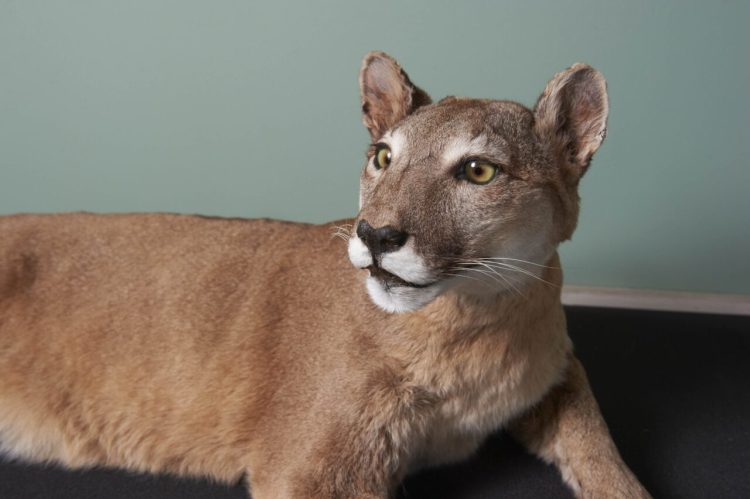
| Felicity — The Puma That Was Actually Captured Museum collections | Inverness Museum and Art… | High Life Highland highlifehighland.com While the Beast of Bodmin Moor remains unconfirmed, Scotland offers a different case. On 29 October 1980, a female puma was captured in a cage trap near Cannich, in the Glen Affric area of the Scottish Highlands. Farmer Donald, known as Ted Noble, set the trap after reports of unusually large cats and concerns about livestock. The animal subsequently became known as Felicity and was taken to Highland Wildlife Park, where she attracted considerable public attention. Her preserved remains eventually entered the collection of Inverness Museum and Art Gallery, providing a tangible record of an exotic feline captured outside captivity in Britain. Felicity matters because her existence is not dependent on a blurred photograph, a fleeting sighting, or an ambiguous footprint. A puma was physically captured, identified and preserved. Whatever explanation we favour for the wider big-cat mystery, we cannot reasonably claim that exotic large felines have never been found at large in Britain. Yet Felicity’s story has its own complications. She was notably tame and overweight when captured, prompting questions about whether she had been living independently for any substantial period. Some accounts suggested she might have been a recently escaped or abandoned captive animal, while other observations and interpretations raised the possibility that she had been feeding outside captivity. Her capture also failed to resolve the earlier reports from the area. Witnesses had described animals that did not necessarily correspond with Felicity’s appearance, and sightings continued after she was removed. It would therefore be misleading to treat Felicity as proof that a wild population of pumas occupied the Scottish Highlands. What she demonstrates is that an exotic large cat could be found loose in the countryside, and that identifying one individual does not automatically explain every other report from the same region. I find that distinction particularly important. Felicity is neither proof of a hidden breeding population nor an argument for dismissing the wider mystery. She is evidence of something quite specific: at least one puma was present outside secure captivity in Scotland in 1980. Sometimes the most useful evidence is not the evidence that answers every question, but the evidence that tells us which questions are worth asking. |
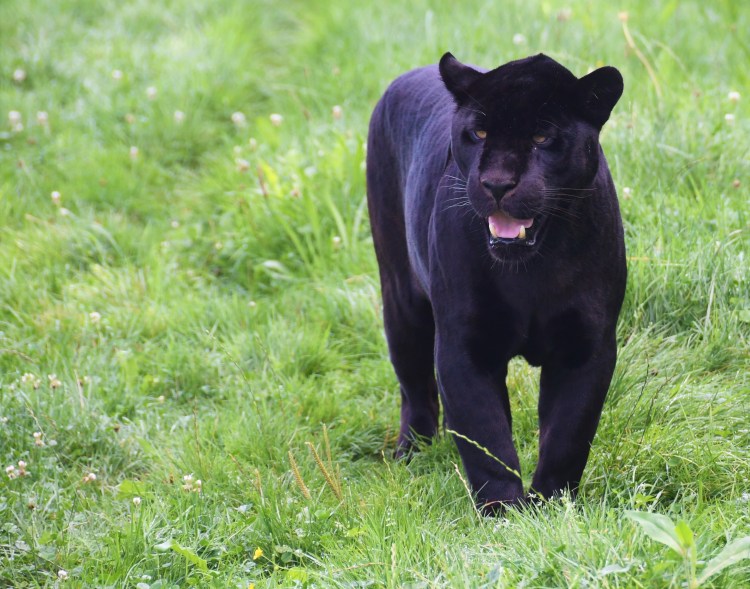
| The Problem With Black Panthers Among the most frequently reported British big cats are animals described as black panthers. The expression has become so familiar that it is sometimes treated as though it identifies a separate species, but zoologically it is not. A black panther is generally a melanistic leopard or jaguar. Melanism involves increased dark pigmentation, giving the animal a black or nearly black appearance. Under suitable lighting, the underlying spotted pattern may still be visible, although it can be difficult to distinguish at a distance. Leopards would be a plausible candidate for some reports because they are adaptable predators with considerable climbing ability and a capacity to exploit varied habitats. Jaguars are also powerful and adaptable, but their natural ecology and the circumstances of their possible introduction would require separate consideration. Pumas, by contrast, are not known to possess a scientifically confirmed melanistic form. Reports of black pumas therefore require particular caution. A witness may have seen a different species, misjudged the animal’s colour in poor light, or used the term puma to describe a large, unfamiliar cat. Size is also a factor. Domestic cats can look remarkably large without a reliable reference point, especially when moving across sloping ground or through vegetation. A cat standing close to a camera may appear enormous against distant trees, while an animal crossing a field at dusk can be difficult to measure accurately. Photographs introduce additional complications. Camera perspective, lens characteristics, shadows and image compression can distort proportions, sometimes making an ordinary animal appear considerably larger than it really is. None of these considerations means that every black-cat report can be explained away. They demonstrate why identification requires more than colour and an impression of size. A convincing observation would ideally include details of body proportions, head shape, tail length, shoulder movement and other anatomical characteristics, supported wherever possible by independent evidence. The difficulty is that unexpected wildlife encounters rarely occur under ideal observational conditions. |
| When Eyewitnesses Get It Wrong — And When They Might Not Eyewitness testimony occupies an uncomfortable position within cryptozoology. On one hand, much of what we know about unusual animal encounters begins with somebody reporting what they believe they saw. On the other, human perception is imperfect, and memory can be influenced by expectation, emotion, lighting and the passage of time. A person who has spent years working with large mammals may be better equipped to recognise certain anatomical characteristics than somebody encountering such an animal for the first time. Familiarity with feline movement, muscular development and body proportions can provide useful observational experience. However, professional experience does not make somebody immune to error. An animal seen briefly at dusk may still be misidentified, particularly if distance or vegetation prevents a clear view. Equally, an inexperienced witness may occasionally provide an accurate description of something genuinely unusual. The sensible approach is to examine the circumstances rather than automatically accepting or rejecting the witness. How long was the animal visible? At what distance? Was there sufficient light? Could its size be compared with a known object? Were distinctive anatomical features observed? Did other witnesses independently describe the same characteristics? It is also important to distinguish between a witness’s observation and their interpretation. Saying that a large, dark, long-tailed feline crossed a road is an observation. Concluding that it was a melanistic leopard is an identification that requires further consideration. One of the more frustrating aspects of the British big-cat debate is the tendency for both believers and sceptics to begin with their preferred conclusion. Some enthusiasts appear willing to accept almost any dark shape as evidence of a panther, while some critics seem equally determined to dismiss reports before examining their circumstances. Neither approach is particularly useful. An investigation is not meant to protect a preferred explanation. It is to establish which explanation best fits the available evidence. What Would a Breeding Population Leave Behind? If Britain really does support established populations of exotic large cats, we should reasonably expect those populations to leave biological traces. A solitary animal can be exceptionally difficult to observe. Leopards and pumas are naturally elusive, often moving through cover and avoiding direct contact with people. Even experienced wildlife researchers working within their recognised habitats may struggle to locate individuals without camera traps, tracking equipment or other specialist techniques. But a population is not simply one animal multiplied in our imagination. It consists of individuals that must feed, reproduce, disperse, become injured and eventually die. Cubs grow into adults, young animals seek territories, and breeding individuals interact over time. Those activities create opportunities for evidence to accumulate. Footprints, hair, faeces, feeding remains, and scent-marking sites may all provide useful information. Recovered carcasses or road casualties would offer particularly strong evidence, while modern genetic techniques can sometimes identify species from relatively small biological samples. Camera traps have transformed wildlife research in many parts of the world, revealing elusive animals that were previously difficult to observe directly. Environmental DNA, commonly called eDNA, offers additional possibilities by detecting genetic material left behind in water, soil and other environmental samples. These techniques are not infallible. Genetic samples can become contaminated, photographs can be misinterpreted, and identifying one individual does not establish a population’s existence. Nevertheless, systematic investigation using several independent methods would provide a much stronger foundation than isolated sightings alone. The most convincing evidence for an established population would involve repeated, independently verified records from a defined area, ideally including evidence of reproduction. A photograph of one leopard would be remarkable, but photographs of multiple identifiable individuals, supported by genetic samples and observations of cubs, would fundamentally change the discussion. That is the standard of evidence serious investigation should aim for. Why the Mystery Refuses to Disappear Despite decades of reports, Britain’s big cats remain a subject of disagreement. Some people are convinced that established populations inhabit the countryside, while others see the phenomenon as a mix of escaped pets, mistaken identity, folklore, and occasional deliberate deception. I suspect the reality may be more complicated than either extreme suggests. No single reason explains every reported encounter. Some witnesses may have seen ordinary domestic cats under misleading circumstances. Others may have encountered genuinely escaped exotic animals. Livestock deaths attributed to big cats may have involved dogs, scavengers or other causes, while a smaller number of incidents could remain genuinely difficult to explain. One confirmed exotic feline does not validate every other report, just as misidentifying one domestic cat does not invalidate all sightings. We should also remember that the countryside is not a static environment. Animals move, habitats change, and human activity creates opportunities for both escapes and accidental introductions. A large cat observed in one region during the 1980s need not have any biological connection with an animal reported elsewhere forty years later. The enduring mystery may therefore consist of several overlapping stories rather than one great hidden population. And perhaps that is what makes the subject so interesting. We are not necessarily searching for a creature unknown to science. We are investigating the possibility that familiar animals have occasionally occupied places where our assumptions tell us they should not be. My Own Position — Between Experience and Evidence I have never been entirely comfortable with the suggestion that Britain’s big-cat mystery can be dismissed simply because the animals are not supposed to be here. Having worked with exotic mammals, I know that large felines are adaptable, powerful and sometimes surprisingly difficult to contain. I also know the British countryside contains potential prey and cover that could support individual animals under suitable circumstances. But there is a difference between believing that an exotic cat could survive in Britain and claiming that established breeding populations have been demonstrated. The first proposition is supported by what we know of feline ecology and documented escaped animals. The second requires evidence that is considerably harder to establish. Experiences beyond professional familiarity also influence my position. During the years I lived in Lincolnshire, I encountered animals that I identified as large exotic felines, including both dark and sandy-coloured individuals. I was also asked to examine the aftermath of an unusual series of sheep deaths near Market Deeping. This incident remains particularly memorable because of the circumstances in which the carcasses were discovered. Those experiences have left me less sceptical than some people about the possible presence of large cats in Britain. They have not persuaded me that every report is accurate, nor have they removed the need for independently verifiable evidence. They have, however, given me good reason to listen when somebody describes an encounter that does not fit comfortably within our expectations of British wildlife. And that brings us to the second part of this investigation. The Mystery Moves to Lincolnshire In the next instalment, we will leave the national legends and historical arguments behind and examine a series of encounters that I experienced personally during my years in Lincolnshire. There was the large black feline that appeared in our headlights near Market Deeping in 2003, another unexpected sighting while walking dogs in Baston, and repeated observations of dark feline shapes moving through fields around Gedney Hill. There was also a particularly unsettling autumn evening on Dunsby Drove, when my two dogs, Wolfie and Dora, sensed something moving through the hedgerow before a large sandy-coloured animal emerged onto the road. Then there was the incident near Market Deeping around 2006, when three adult ewes were discovered dead following a single night. One of those animals was found lodged high in the fork of a tree, and I was asked to examine the scene because of my professional experience with exotic mammals. I will describe what I witnessed, explain why I reached the conclusions I did and distinguish those observations from what could be independently established. The original photographs of Wolfie and Dora, together with annotated images of the Dunsby location, will help document the circumstances of one encounter in particular. Whether readers agree with my interpretation is entirely their decision. For now, Britain’s big-cat mystery remains an intriguing mixture of established historical facts, ecological possibilities, uncertain sightings and unanswered questions. Individual exotic felines have unquestionably been found outside captivity, but the existence of long-established breeding populations remains unproven. That is neither a reason to believe every report nor an excuse to stop investigating. Listen. Investigate. Reach your own conclusion. Case File 06 — Part One remains open. |
| Case Assessment |
| STATUS: INDIVIDUAL EXOTIC CATS CONFIRMED — ESTABLISHED BREEDING POPULATIONS UNPROVEN Documented captures demonstrate that exotic large felines have occasionally been present outside captivity in Britain. Historical private ownership, escapes and possible releases provide credible explanations for individual animals appearing in the countryside. Britain contains habitats and prey resources that could potentially support certain large feline species. However, establishing breeding populations over successive generations would require compatible animals, successful reproduction, and sufficient genetic diversity. Reliable evidence demonstrating such populations remains insufficient. The mystery therefore concerns not whether an exotic cat could ever appear in Britain, but whether some have survived and reproduced beyond isolated incidents. |
| Further Exploration |
| For readers who wish to examine the historical evidence and official material behind this investigation, the following sources provide useful starting points. Dangerous Wild Animals Act 1976 — The original legislation governing the private keeping of specified dangerous animals. Inverness Museum and Art Gallery — Felicity the Puma — The museum’s account of the puma captured near Cannich in October 1980. UK Parliament — Big Cats (Norfolk), 1998 — Parliamentary discussion of British big-cat sightings, official investigations and the evidence examined in the Bodmin Moor case. These sources help distinguish documented captures and official findings from the broader claims surrounding Britain’s alien big cats. |
| Wander through the Article Directory and see where curiosity takes you next. |
| About our writing & imagery Most articles reflect our real gardening experience and reflection. Some use AI in drafting or research, but never for voice or authority. Featured images may show our photographs, original AI-generated artwork, or, where stated, credited images shared by others. All content is shaped and edited by Earthly Comforts, expressing our own views |


Rory, what a fascinating, exceptionally well-written piece! I thoroughly enjoyed reading this. ❤️
What I particularly appreciate is your balanced approach: neither dismissing eyewitness accounts outright nor accepting every mysterious sighting as proof of a hidden big-cat population. Your distinction between observation and interpretation is so important, as is your reminder that individual exotic cats being found outside captivity does not establish a breeding population.
Poor Felicity’s story made me sad. Having encountered human-kept baboons and vervets myself, as I raised and rehabilitated them with a permit from Nature Conservation to do that, I know how complicated the relationship between wild animals and humans can become. It makes one wonder about her history and how she came to be there.
Your professional experience brings another fascinating dimension to this subject, and I love that you leave room for questions without claiming to have all the answers. Could individual big cats have survived in parts of Britain? It’s an intriguing possibility, even though the evidence for established breeding populations remains insufficient.
And that’s what makes mysteries like this, Loch Ness and Bigfoot so fascinating to me. One doesn’t have to believe every claim to enjoy exploring the possibilities!
Of course, if such magnificent animals do exist, I hope they can remain undisturbed, without their locations being broadcast to the world. Let them live in peace and retain a little mystery! 😊
Thank you for such a thoughtful and engaging read. I’m looking forward to the next instalment! 🙌❤️
LikeLiked by 1 person
Glad you are enjoying reading the series Sonel as much as l am writing them. There are only a few of my readers who enjoy the long form content preferring l should image 600 word reads opposed to 3000. So, l thank you for your comment.
LikeLiked by 1 person
You’re very welcome, Rory! 😊❤️ Personally, I love a good long read when the subject captures my interest, and your series certainly does that. I enjoy having the time to explore all the details and follow the story rather than just skim the surface. I’ll happily keep reading, even if I’m one of the few who enjoys the longer version. I am way too busy enjoying myself when I read all the lovely and interesting posts and stories you are writing to worry about the length of it. 🌿📚❤️
I don’t know about other bloggers but I myself would not settle for a quick 600-word summary. Some of us want to settle in, grab a cup of coffee, and follow the trail wherever it leads. ☕📚❤️
LikeLiked by 1 person
Thanks, Sonel.
I was discussing with Suze how long I’ve been blogging, and I realised it’s been nearly 20 years, in one form or another.
Back in 2015, I wrote long-form content (LFC) for a gaming community, and before that, I edited a legislation-focused forum that supported my brokerage business. LFC has always been my preferred writing style. Like you, I enjoy settling down to read something substantial, something I can really get my teeth into.
In 2017, I started a blog called A Guy Called Bloke here on WordPress, which became very popular. However, in 2022, I deleted it and started this blog, which was originally intended to be 100% gardening-focused. At the time, I had just started my gardening business, and it felt like a natural fit, especially since I was already writing about my love of worm farming.
But eventually, I became a little bored with writing exclusively about gardening.
Things began to change towards the end of last year when I asked myself, “Well, what if we changed the style a little?” And from that simple question, the blog gradually evolved into something I genuinely love.
Looking back, I think one reason I struggled so much with A Guy Called Bloke was that I was constantly at loggerheads with it. Despite its popularity, I never really liked the blog. There were always so many expectations about what I should deliver, how often I should post, which prompts I should participate in, and how many other bloggers I needed to visit each day to maintain engagement and increase readership.
It became incredibly hard work, and for years I wrestled with the idea of simply deleting it. Eventually, in 2022, I did.
This blog has changed enormously since those early gardening days, but the biggest difference is how I feel about it.
Now, I have a blog I genuinely enjoy adding content to, and more importantly, I do it entirely my way. I know my readership is relatively small, but that really doesn’t matter to me. I want to write, and I want to keep writing. I no longer have those internal conflicts about what I should publish, which prompts I ought to schedule, or how much time I need to spend visiting other blogs to maintain popularity.
That sort of blogging is hard graft, and it simply isn’t me.
These days, I write because I’m curious, because something interests me, and because I enjoy exploring subjects in greater depth. If others enjoy what I write, that’s wonderful, but the enjoyment of writing itself matters most.
Later this year, I’m also planning to change the website’s URL to reflect the blog’s name. It will no longer sit under the Earthly Comforts address but will have its own identity, completely separate from the gardening business.
In many ways, I suppose it’s taken me nearly 20 years to arrive at the sort of blog I always wanted to write.
And, for once, I’m thoroughly enjoying the journey.
LikeLiked by 1 person
Rory, I can relate to this so much! ❤️ I also had a blog called Sonel’s Corner many years ago that became quite popular, but eventually, all the expectations around what to post, how often to post, which prompts to participate in, and how much time to spend visiting other blogs began to take the enjoyment out of it for me. I eventually deleted it too.
After moving into digital advertising, I started blogging again, but Creative Soul has gradually become something much more personal to me. These days, I write when something inspires me, share photographs when I capture something special, and spend just as much time enjoying the wonderful blogs of others. Sometimes I find myself laughing, sometimes reflecting on life, and sometimes a post inspires me to grab my camera or put my own thoughts into words.
Just like you, I’ve stopped worrying about whether I publish something every day or whether my readership grows. If I don’t feel like writing, that’s perfectly fine. There is so much enjoyment in simply being curious, discovering new things, appreciating other people’s creativity, and allowing inspiration to come naturally.
I think that’s what makes blogging special when we reach this point. It becomes less about expectations and more about the pleasure of the journey itself. And that’s exactly where I want to be.
I love what you’ve done with your blog, Rory, and I always enjoy seeing where your curiosity takes you next. It’s lovely to discover that, in our own different ways, we’ve arrived at a similar place. Here’s to continuing to write, explore, and enjoy the journey, entirely on our own terms! ❤️
LikeLiked by 1 person
With this blog, l have learned to start loving a blog again, l correct myself, l have learned to love my blog. yep l am terrible at keeping up to speed with the other bloggers, l read a handful l enjoy. I write mostly for myself now, and l can live with that. I know people read the content – the figures tell me so. I write what l want, and yes l am prolific. Maybe too much so. I am mostly LFC and that can be a lot for some.
But l am in training again to try and write a book.
As you say, these days everything is on our terms 🙂
LikeLiked by 1 person
Rory, I love that you’ve found your way back to enjoying your blog, and I think there’s something quite liberating about reaching that point where you can simply write what you want, when you want, and let the rest take care of itself. ❤️
And I wouldn’t worry about being prolific! 😂 You have your interests, I have mine, and that’s the beauty of blogging. We can wander through each other’s little corners of Blogland, enjoy what catches our attention, and never feel obliged to read or write everything.
Of course, I think one of the reasons I enjoy your blog so much is that we clearly share many of the same interests. I love seeing where your curiosity takes you, whether you’re writing about nature, photography, or something else that has caught your attention. There’s always something interesting to discover, and I genuinely enjoy your writing.
But now you’ve got me interested in this book you’re training yourself to write! I hope you enjoy that journey just as much as you’ve rediscovered the pleasure of blogging. There’s something wonderful about creating something because you want to, rather than because you feel you ought to.
Here’s to writing for the love of it, Rory, and allowing our curiosity to lead us wherever it may. Entirely on our own terms! ❤️
LikeLiked by 1 person
Morning Sonel – here is the link to the pilot, l will run a small series in the blog first – https://earthlycomforts.uk/2026/10/26/the-ministry-of-misbehaving-gardens/
For me its the same reason – l love that l am allowing a more me version of variety to be published 🙂
LikeLiked by 1 person
Morning, Rory! ❤️ Thank you for sharing the link with me! I’ve just had a look, and goodness, you’ve certainly opened the door to a whole new world with this one! 😂🌿
The Ministry of Misbehaving Gardens sounds wonderfully intriguing, and I love the idea of combining gardening, mystery, folklore, fantasy and your own distinctly British humour. A greenhouse that starts behaving strangely at Christmas? I have a feeling those gardeners are in for considerably more than they bargained for! 😂
I also love what you said about allowing a more “you” version of variety to be published. I think that’s wonderful, because it gives you the freedom to explore different ideas and let your imagination take you wherever it wants to go. Why limit yourself to one kind of writing when there are so many possibilities waiting to be explored?
I’m looking forward to following the pilot series on your blog and seeing how the Gardenverse develops. And who knows what other curious creations might emerge from that imagination of yours! Wishing you every success with this new adventure, Rory. ❤️🌿
LikeLiked by 1 person
Thank you – yes, l have tried sitting down to write several books over the last 15 years, many ended up as tales in this blog after being stored in files, others were thrown away, some ended up as poems, but a few concepts were stored in dark corners, waiting to see the light – the gardening has awakened certain darker shades of green with me and l see a future writing about foliage fantasy 🙂
LikeLiked by 1 person
Rory, I love the idea of those stories and concepts that have been waiting patiently in the dark corners, just waiting for the right moment to see the light! 🌿 And now gardening has awakened those darker shades of green and given them a new direction. I think *foliage fantasy* sounds wonderfully intriguing, and I can only imagine what might be lurking beneath all those leaves! 😂 There’s something rather lovely about the way our interests and experiences can open unexpected doors in our imaginations. Perhaps those stories weren’t waiting to be written until you found the right words, but until you found the right world for them to grow in! I’ll be watching this space with curiosity, Rory! 🙂🙌❤️
LikeLike