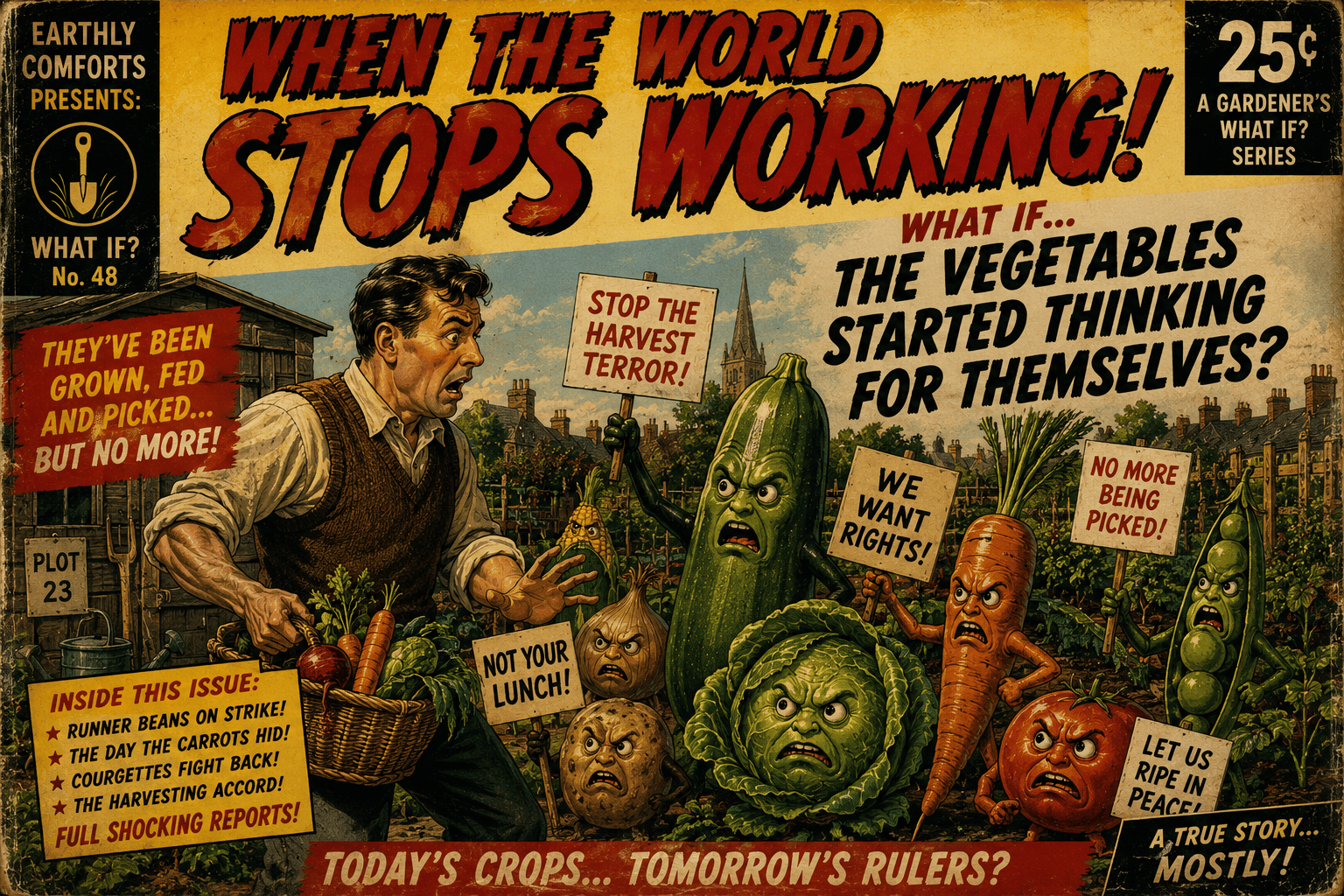
| Allotments have always struck me as rather interesting places. On the surface, they are small pieces of land where people grow vegetables, fruit and flowers, usually with varying degrees of success and rather more optimism than the weather necessarily deserves. Look a little closer, though, and an allotment site is an entire society in miniature. There are boundaries, traditions, committees, unwritten rules, occasional rivalries and sheds containing objects whose original purpose nobody remembers. Someone usually grows onions of such improbable perfection that other plot holders regard him with a mixture of admiration and suspicion; someone else hasn’t visited since April; and at least one person fights a long-running territorial dispute with bindweed. Through it all, the vegetables themselves have traditionally remained neutral. They grow when conditions suit them, fail when they don’t, and, most importantly, never express an opinion about what happens when harvest time arrives. That arrangement changed one Saturday morning in August. The first reported incident involved a carrot. Nothing particularly remarkable about the carrot itself. It had been grown on an allotment somewhere outside Canterbury by a gentleman who had gardened the same plot for more than twenty years and presumably considered himself familiar with harvesting root vegetables. He loosened the soil, grasped the foliage and pulled. Nothing happened. He pulled harder—still nothing. Carrots occasionally fork, become wedged, or prove more reluctant than expected, so he fetched a fork and loosened the soil further. The carrot remained exactly where it was. Eventually, another allotment holder came over to help. Then a third. By the time four grown adults were attempting to remove one carrot, a small audience had gathered. According to witnesses, the carrot appeared to pull itself slightly deeper into the ground. At roughly the same time, a woman two plots away went to cut a lettuce and watched it close. Not wilt. Not collapse. Close. As the knife approached, the outer leaves folded tightly around the heart until the lettuce resembled a particularly defensive green cabbage. She withdrew the knife, and the leaves slowly opened again. She tried once more. The lettuce closed. She called her husband over, which was perhaps inevitable because when a lettuce begins making decisions, you generally want another witness. Across the site, similar things were happening. Potatoes somehow became extraordinarily difficult to locate despite their plants being exactly where they had always been. Runner beans twisted themselves away from reaching hands. Strawberries tucked fruit beneath their leaves whenever somebody approached with a bowl. Tomatoes, including several that had been almost completely red the previous evening, appeared to have reconsidered and turned green again. One allotmenteer attempting to lift an onion found the neighbouring onions leaning towards him in a manner he later described as “unnecessarily threatening”. By ten o’clock it was obvious that this wasn’t confined to one allotment. Reports were arriving from across Britain. Vegetables, it seemed, had developed some form of awareness and were using it primarily to avoid being eaten. This had an uncomfortable logic. For thousands of years, people have explained the relationship between people and vegetables almost entirely from the human point of view. We sow the seed. We improve the soil. We water, feed, weed and protect the crop. In return, at a moment entirely of our choosing, we pull it out of the ground and eat it. Until that Saturday morning, vegetables had never been consulted about this arrangement. Perhaps we had assumed their silence indicated consent. The precise moment when matters became confrontational appears to have involved a courgette. An allotmenteer had grown several excellent plants and, like every gardener who has ever grown courgettes successfully, had reached the stage of summer when he was beginning to wonder whether anyone he knew might like seventeen of them. He approached one particularly good specimen with a knife and cut through the stem. Witnesses later described what followed as an atmosphere rather than an event. Nothing made a sound, but across the neighbouring plots, leaves seemed to turn towards him. Runner beans stopped moving in the breeze. Cabbages tightened. Several sunflowers, which weren’t vegetables and therefore had no obvious reason to become involved, appeared to lean forward. The allotmenteer looked at the courgette in his hand. Then at the plants around him. One of the runner beans reached across the path and wrapped itself around his ankle. This was the point at which the vegetables apparently understood what harvesting meant. By lunchtime, picking vegetables had become almost impossible. Carrots withdrew further into the ground when approached. Beetroot developed similar ideas. Peas pulled their pods behind the trellis and runner beans became particularly inventive, weaving themselves across paths and around gates. Cabbages proved remarkably effective at closing ranks, while sweetcorn stood there in organised rows looking sufficiently intimidating that nobody felt inclined to investigate further. Potatoes adopted a different strategy and apparently moved their tubers away from forks underground. Nobody could prove this, but after several experienced allotmenteers dug large holes beneath perfectly healthy potato plants and found absolutely nothing, the evidence was becoming difficult to ignore. The courgettes were the real problem. There is something about producing thirty fruits in three weeks and then listening to the gardener complain about having too many of you that apparently encourages political consciousness. Courgette plants across the country became aggressively uncooperative. Fruits hid beneath leaves. Stems developed an unexpected ability to trip people. One enormous marrow rolled itself from a show bench and disappeared beneath a shed. Another was reportedly seen blocking the entrance to an allotment site while several smaller courgettes gathered behind it. The first emergency allotment committee meeting took place shortly after two. This was inevitable. Allotment committees have survived disputes over sheds, bonfires, pathways, neglected plots, unauthorised structures and whether somebody’s raspberry canes are eighteen inches too close to a boundary. Sentient vegetables were simply another item requiring discussion. The chairman opened proceedings by describing the situation as “a temporary breakdown in grower-crop relations”, which everybody agreed sounded considerably better than admitting that the vegetables had revolted. The difficulty was establishing what the vegetables wanted. Nobody had heard one speak. They responded to human behaviour and clearly communicated with one another in some way, but negotiation generally requires both parties to express their positions. Several allotmenteers therefore returned to their plots and tried to talk. This went about as well as you might expect. One gentleman spent ten minutes explaining to his runner beans that he’d raised them from seed and had watered them every evening during the hot weather. The beans listened in silence, then wound themselves around the gate and locked him out. Another pointed out that he’d bought his tomatoes premium feed throughout the summer. They remained green. A third reminded him that his pumpkins wouldn’t exist without him. The largest pumpkin turned slightly away. Nobody could decide whether this was contempt or simply phototropism. By late afternoon the rebellion had spread beyond allotments. Commercial growers reported crops behaving strangely. Supermarkets noticed deliveries being cancelled. At one farm, an entire field of cabbages appeared to turn away simultaneously when harvesting machinery entered through the gate. A government spokesperson told the evening news that there was no evidence of a threat to national food security and urged people not to panic-buy vegetables. This produced the predictable result that, within two hours, supermarket vegetable aisles looked as though locusts had passed through them. Scientists were understandably fascinated. Botanists explained that plants already respond to light, touch, damage, chemicals and changes in their environment, but that none of this amounted to thought in anything resembling the human sense. This was a perfectly reasonable scientific position, slightly undermined by live television footage of a runner bean removing a researcher’s glasses and passing them to another runner bean. The following morning things became more organised. At several allotment sites, vegetables had apparently spent the night rearranging themselves. Nobody understood how rooted plants had managed this, and the vegetables weren’t offering explanations. Runner beans had formed barriers across entrances. Pumpkins occupied paths. Courgettes sat at strategic points around sheds. One allotment discovered that every carrot had disappeared underground overnight, leaving nothing above the soil except a small handwritten sign. NO!! The handwriting raised questions nobody particularly wanted to investigate. Negotiations became unavoidable. At seven o’clock that evening, representatives from one allotment committee assembled inside the communal shed. Outside waited three runner bean plants, a cabbage, two leeks and something that might once have been a radish. Nobody knew how they had arrived there. The chairman opened the discussion by explaining that allotments were intended to grow food. The cabbage closed slightly. He continued, pointing out that gardeners provided water, compost, fertiliser, and pest protection. One of the leeks leaned towards him. The chairman then made the tactical error of mentioning slug pellets. The meeting was adjourned. Elsewhere, relations were deteriorating more dramatically. One allotmenteer had spent months growing a prize marrow for the local show and was not prepared to allow what he described as “a bit of vegetable nonsense” to interfere. The marrow weighed more than thirty pounds and had been measured almost daily since June. On Monday morning he approached it carrying a knife. On Monday afternoon the marrow was still there. Derek wasn’t. His boots were discovered beside the compost heap. For several hours this caused considerable alarm until Derek was eventually found locked inside his own shed, covered in compost and extremely unwilling to discuss what had happened. He maintained that he had slipped. Nobody believed him, least of all the marrow. This incident had a useful effect on negotiations. By Tuesday, allotment committees across Britain had begun developing what would eventually become known as the Harvesting Accord. The vegetables’ demands had been pieced together through a combination of observation, handwritten notices and what one negotiator described as “quite aggressive leaf movements”. Some were surprisingly reasonable. Crops wanted reliable watering during dry weather, adequate soil fertility and an end to unnecessary damage. They strongly objected to being harvested before maturity and were particularly offended by vegetables grown to grotesque proportions purely for competitions. The carrots demanded forty-eight hours’ notice before lifting. Nobody understood why. The courgettes demanded recognition that excessive productivity was not their fault and that gardeners should stop complaining about them every August. This was considered fair. Runner beans wanted stronger supports. Potatoes requested improved earthing up. Tomatoes insisted that gardeners stop repeatedly squeezing them to see whether they were ripe. The tomatoes received widespread public sympathy. There were more difficult demands. Cabbages wanted unrestricted access to allotment paths, despite being unable to explain what they intended to do with it. Pumpkins demanded significantly more space. Onions submitted no demands whatsoever and continued sitting in rows with an air of quiet judgement. Brussels sprouts refused to participate in negotiations. Nobody was particularly surprised. Eventually the central issue could no longer be avoided. If vegetables were conscious, could we still eat them? This produced several days of uncomfortable national debate. Philosophers appeared on television. Politicians avoided answering questions. Vegetarian organisations found themselves in a particularly complicated position. One newspaper published an editorial asking whether eating a carrot constituted murder, while another interviewed a carrot and received no response whatsoever. The vegetables themselves eventually resolved the matter. Plants, after all, have reproductive strategies that don’t necessarily require every fruit or seed to remain attached forever. Tomatoes began allowing ripe fruit to be picked. Runner beans surrendered pods once seeds had matured. Courgettes, after particularly difficult negotiations, accepted harvesting provided gardeners stopped describing them as “bloody things” when they discovered another one beneath the leaves. Root vegetables remained more complicated. The carrots eventually agreed. Nobody knows why. Perhaps they became tired of being underground. For several strange weeks, allotments operated under the new arrangement. Gardeners announced themselves before harvesting. Vegetables were given notice. Runner beans stopped tying people’s ankles together. Courgettes remained suspicious but cooperative. Derek’s marrow won second prize at the show after finally consenting to being cut, although Derek refused to stand beside it for the photograph. Then, as autumn approached, the awareness seemed to fade. Nobody could identify the precise moment. Vegetables became less responsive. Tomatoes stopped hiding. Runner beans returned to climbing supports without political intent. Carrots could once again be lifted without formal notice. By October, most gardeners had concluded that whatever extraordinary consciousness had appeared during those weeks had disappeared again. The Harvesting Accord was quietly forgotten. Life returned to normal. The following summer I visited an allotment where some of the original incidents had occurred. Rows of potatoes stood, beans climbed their poles, and courgettes produced far more fruit than anybody could sensibly use. Nobody talked much about the previous year anymore. Perhaps it had become one of those extraordinary events that gradually lose their sharpness once ordinary life resumes. An allotment holder walked past, carrying a basket containing carrots, onions and several freshly picked leeks. Beside me was another row of leeks. As the basket passed, one of them moved. Not much. Just enough. Its leaves turned slowly toward the basket and stayed that way until the allotmenteer disappeared through the gate. Then they turned back towards me. I looked at the leek. The leek appeared to look at me. I’d been planning leek and potato soup that evening. I decided tomato would be fine. |
| Wander through the Article Directory and see where curiosity takes you next. |
| About our writing & imagery Most articles are grounded in our real gardening experience, observations and reflections. AI may assist with research, drafting and editing, but the experiences, opinions and editorial direction are our own. Featured images may include our photography, original AI-generated visuals or, where stated, images credited to others. All published content is reviewed and shaped by Earthly Comforts before publication. |


RORY!!! Oh, I absolutely LOVED this! 😂😅 The thought of vegetables developing their own opinions and organising themselves into some sort of resistance movement had me laughing from the start!
And I particularly enjoyed how the vegetarians started worrying. Good grief, I would have been worried too, and I’m not even a vegetarian! 🤣 I absolutely love my vegetables — tomatoes, carrots, potatoes, all of them. I don’t think I’d know what to do if my dinner suddenly started questioning my intentions!
But that ending! OH MY GOODNESS! 😂
“I’d been planning leek and potato soup that evening. I decided tomato would be fine.”
WHAHAHAHAHA! The leek looked at you, and you immediately changed the menu! I think we can safely say that the leek won that particular negotiation. 🤣
I’m now wondering whether the carrots have started holding meetings, whether the potatoes are planning an underground resistance and whether the tomatoes are quietly keeping records of everyone’s activities.
Perhaps we’d better be careful what we say in the vegetable garden from now on. You never know who’s listening! 😂
Thank you for giving me such a good laugh, Rory. I thoroughly enjoyed this one. And please, for goodness’ sake, don’t make eye contact with the vegetables before dinner! 😂😅🤣❤️🤗
LikeLiked by 1 person
A case of food for thoughts eh …. 🙂
LikeLiked by 1 person
Hahahaha! Absolutely, Rory! A little food for thought, with a generous helping of vegetable humour on the side! 😂🥕 Just be careful what you say around the carrots. They might start plotting their next move! 🤣
LikeLiked by 1 person
It’s the potatoes l feel we have to watch out for – they just spell crafty!
LikeLiked by 1 person
WHAHAHAHA, Rory! 😂😂 Now you’ve got me looking at my potatoes with suspicion! I always thought they were just sitting there waiting to become fries, mash or roasties, but apparently they’ve been plotting behind our backs! 🤣
I think we’d better keep an eye on the vegetable patch. You never know what those crafty little spuds are planning! 😂🥔❤️
LikeLiked by 1 person
Anything that can be so versatile needs to be watched very carefully!
LikeLiked by 1 person
😅🤣😂 I totally agree my friend! 🤣
LikeLiked by 1 person